traditional
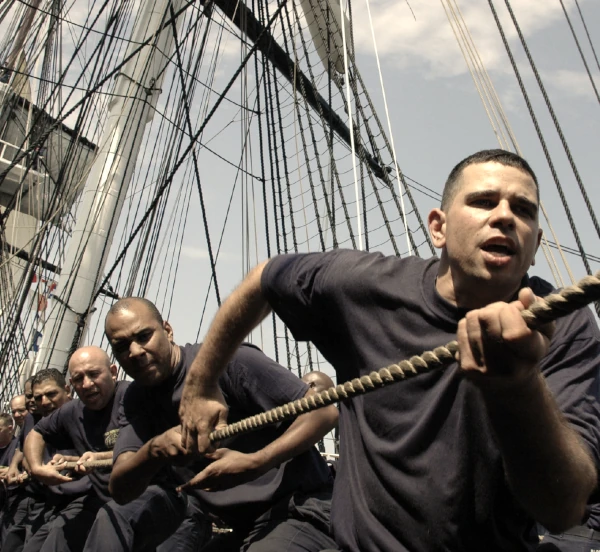
Phrases like "drunk as a sailor" and "spending money like a drunken sailor" have been common in many languages as long as the term "sailor" itself has been used. Even today, as "sailor" is a dying nourishment, most substituted by data operators and other more or less educated people, it's used at least figuratively spoken. Were the old sailors really that bad?
Well, they had neither wings nor halo, but the blame may be put mainly on the lack of proper freshwater during long journeys. Before filtration and modern water tanks was incorporated aboard, it was much easier to store alcoholic liquid than clear water. In addition came the temptation finally reaching the port, planting their feet on the ground and finding beer and booze floating like a river. Even angels would have lost their wings and crashed.
Marines faced the same challenge, and bad habits have obviously been inherited until these very days. In March 1794, the daily ration established by Congress for the US Navy included "one half-pint of distilled spirits" or "in lieu thereof, one quart of beer". This was gradually limited and finally prohibited on board in July 1914, but not at port. In Iceland in 2018, some thousand Marines completely emptied out the city of Reykjavík for beer during a NATO mission.
Nowadays, they're probably smoking, popping and snorting instead ...
This shanty has, like almost any shanty, a hazy origin, but seemingly it dates back to the 18th century and "Óró Sé do Bheatha ‘Bhaile" from the Jacobite Uprise - a welcome song for the catholic "Bonnie Prince Charlie" attempting to conquer the throne from the protestant Hanoverians. About a hundred years later, it was turned into a sea shanty and mainly used as a working song hauling the rope to hoist the sails; marching along the deck. As the ships grew smaller and the staff fewer, steamboats taking over heavy loads, the use of the song moved on to simpler and other tasks like heaving the windlass or capstan. Then it declined and was about to cease, but thanks to collectors a variety of lyrics were published up through the nineteen hundreds. A selection is listed down under, with publishers mentioned.
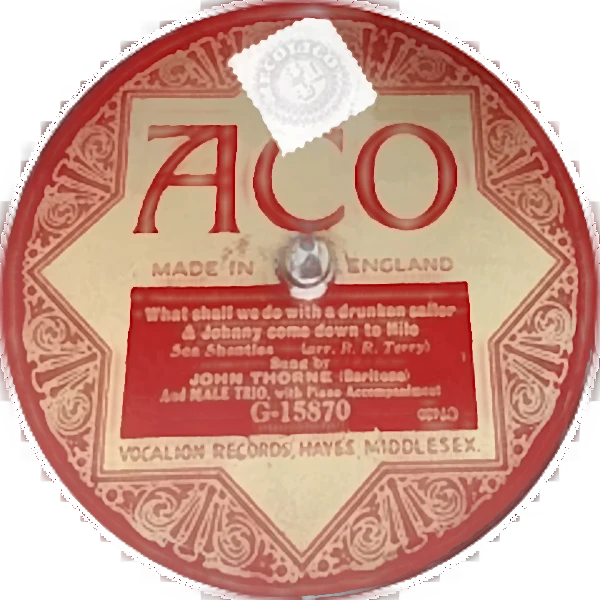
Then the landlubbers grabbed it, and brought it on to stage. Already in 1906, Percy Grainger recorded Charles Rosher singing it in London, ending up on wax cylinder. First officially registered commercial recording was with John Thorne in February 1926; an annoying and short up-tempo version confirming that he would sing anything for money. And that bloke pronounced "early" proper English ɜːrli: . A salty Irish and a proper Busker pronounces it ɜːrlaɪ.
The first prominent artist to record it was Burl Ives: an a capella version together with the Ralph Hunter Singers for his 1956 album "Down to the Sea in Ships". He made it with a twist: nowadays the melody briefly follows the usual Minor Scale, but Ives is true to the Dorian Scale it is traditionally noted down with, and on "earlie" he lowers the seventh half a note. I've never heard anybody else do this, but I bet this is the way they used to sing it some two hundred years ago!
The Irish Rovers have made it a stunt to round up all their concerts with this song, ever since some 50 years ago. That's why I leave you their choice of verses. But I encourage you to make your own variant. My favorite is "lock him in a room with bagpipe players".
what shall we do with a drunken sailor?
what shall we do with a drunken sailor?
what shall we do with a drunken sailor?
early in the morning
way hay and up she rises
way hay and up she rises
way hay and up she rises
early in the morning
shave his belly with a rusty razor
shave his belly with a rusty razor
shave his belly with a rusty razor
early in the morning
way hay ...
put him in a longboat till he's sober
put him in a longboat till he's sober
put him in a longboat till he's sober
early in the morning
way hay ...
stick him in a scupper with a hosepipe bottom
stick him in a scupper with a hosepipe bottom
stick him in a scupper with a hosepipe bottom
early in the morning
way hay ...
put him in the bed with the captains daughter
put him in the bed with the captains daughter
put him in the bed with the captains daughter
early in the morning
way hay ...
that's what we do with a drunken sailor
that's what we do with a drunken sailor
that's what we do with a drunken sailor
early in the morning
way hay ...
«Put [lock] him in the guard room 'til he gets sober»
«Scrape the hair off his chest with a hoop-iron razor»
«Give 'im a dose of salt and water»
«Stick on his back a mustard plaster»
«Keep him there and make 'im bail 'er»
«Give 'im a taste of the bosun's rope-end»
«Soak him in oil till he sprouts a flipper»
«What'll we do with a Limejuice skipper?» [answer in next verse]
«What shall we do with the Queen o' Sheba?» [answer in next verse]
«What shall we do with the Virgin Mary?» [answer in next verse]
Stan Hugill : "Shanties from the Seven Seas", London 1961. It picks up these lines and states that the first published description of the shanty is found in an account of an 1839 whaling voyage out of New London, Connecticut, to the Pacific Ocean.
«Put him in [chuck him in] the longboat 'til he's sober»
John Masefield : "A Sailor's Garland", Methuen & Co. 1906
«Put him in the longboat and make him bail her»
Captain W. B. Whall : "Sea Songs and Shanties", Brown, Son and Ferguson 1910
«Put him in the scuppers with a hosepipe on him»
«Pull out the plug and wet him all over»
«Tie him to the taffrail when she's yardarm under»
«Heave him by the leg in a runnin' bowline»
Richard Runciman Terry : "The Shanty Book, Part I", J. Curwen & Sons 1921
«Shave his chin with a rusty razor»
Dennis Wheatley : "They Found Atlantis", Hutchinson & Co. 1936
For lyrics only, fullscreen b&w, go HERE and press F11. Hit the blue bullet or press backspace to return.
Go HERE for a list of existing cheatsheets.
For the following CHORD section, fullscreen/horizontal mobile is recommended.
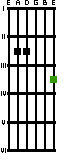
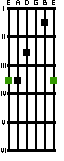
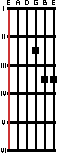
Em
what shall we do with a drunken sailor?
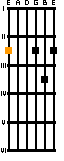
D
what shall we do with a drunken sailor?
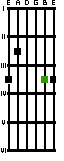
Em                        G
what shall we do with a drunken sailor?
D             Em
early in the morning

Em
way hay and up she rises
D
way hay and up she rises
Em          G
way hay and up she rises
D             Em
early in the morning
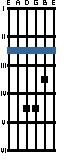
There's no composer alive to flame me, so I'm flipping with this: I end the verse [Bm] instead of [Em]; then move to sing higher second part for the chorus [Bm] ... [Em] way hay and up she rises [D] way hay and up she rises [Em] way hay and [C] up she rises [Dsus4] early in the [Em] morning ...